
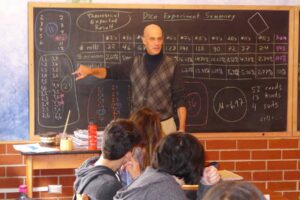
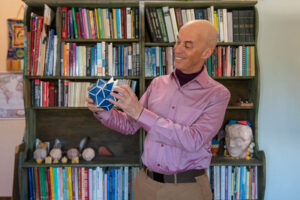

Teacher: Niek Slooter (Read more about his biography here)
Dates for 4-Week Course: September 7 to October 2, 2026
Times for Live Sessions: Monday through Thursday, Starting at 9:15am MT (which is 11:15am ET and 8:15am PT). Each live session lasts between 50 and 70 minutes. On Friday at 9:15am MT there will be student group meetings.
Course Description
During this main lesson block, we will explore different perspectives on historical atom models, as well as the latest discoveries in the field of chemistry. We continue by using the most accepted atomic model and the elementary particles they consist of to gain a deeper understanding of the periodic table and how it is organized.
Comparisons between metals, alkali metals, and noble gases will be discussed and related to electron shells, along with their functions. The different types of chemical bonds will be covered, practiced, and related to the features of different elements.
From there, we move to basic chemical formulas and how these can be balanced. This will include the proportions between atoms in molecules and the reactants/products in more complex chemical reactions. Practicing with complete combustion reactions and how to write these down will also be part of this course. We will do calculations on average atomic masses and molecules, as well as with mols, gas constants, and concentrations in liquids and gases.
During this main lesson block, the definition of salts, precipitation reactions, and how salts influence osmosis will be covered and practiced with hands-on experiments. The differences and comparisons of enantiomers and isomers, and how these are formed will be studied.
After each lesson, practice questions, calculations, or visualization assignments will be given to review the content from class. We will end this course with an open-book test on which the students are able to contribute by creating several questions and answers themselves.
Topics covered:
• Atom models
• Elementary particles
• Periodic table
• Electron shells & isotopes
• Metals, metalloids and non-metals
• Completing formulas & Stoichiometry
• Combustion reactions
• Enantiomers & isomers
• Atomic mass & moles
• Concentrations & moles
• Gas constants & moles
• Chemical calculations
• Bonds & Electron shells
Materials will be shipped.
If you register your student for a science program and live outside the US, we will send you an invoice for an additional $30-$50 for your science kit shipping, depending on your location.