

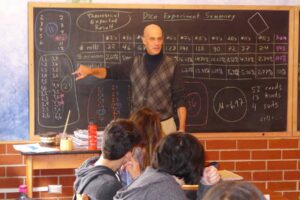
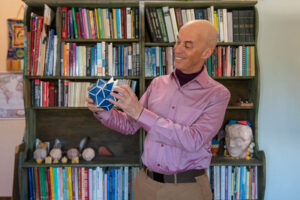

Teacher: Niek A.H. Slooter
(Read more about his biography here)
Dates for 8-week course:
Biology: January 23 to March 26, 2027 (with one week off for February Break)
Chemistry: March 29 to May 28, 2027 (with one week off for Spring Break)
Times for Live Sessions: Mondays and Wednesdays starting at 10:30am MT. Please note that all times are given in Mountain Time (MT), which is two hours behind ET, and one hour ahead of PT. Each live session lasts between 50 and 70 minutes.
Course Description: Biology
This NEW eight-week course for 11th and 12th graders will start with the basic concepts in biology, including what determines living organisms, photosynthesis, respiration, as well as a summary of the anatomy and physiology of humans. From there, we will focus on evolution and natural selection, the processes by which species adapt to their environments and change over generations. Common ancestry and phylogeny will also be part of this topic. Microbiology and the study of bacteria will be used to have a detailed perspective on evolution.
We will look into ecology and study ecosystems, food webs, symbiotic relationships, and how living things interact with their environment. We will combine this with conservation biology and how we influence habitats and populations. During the last week, we will do behavior studies, make an ethogram, and look for differences and comparisons between animals and humans.
The course will have many hands-on assignments, practices, and small experiments with observations in and around the house. The unit will end with an open-book test to see if all topics are understood and can be applied by the student.
Topics covered
- Photosynthesis and respiration
- Anatomy and physiology of the human body
- Microbiology and the evolution of bacteria
- Evolution of plants
- Evolution of mammals
- Natural selection
- Ecology
- Conservation biology
- Behavior
Course Description: Chemistry
During this NEW 8-week course, we will start with different historical atom models, as well as the latest discoveries in chemistry research projects. We will continue with basic formulas, how these can be balanced, the proportions between atoms in molecules, and reactants/products in more complex chemical reactions. From there, we go over atomic masses, molecular calculations, gas constants, and concentrations in liquids and gases. We will look into how atoms bond together and how molecules form. The students will also study molecular geometry and different molecular shapes (VSEPR theory), and intermolecular forces influence this.
These topics will be used to study areas such as gas laws, the behavior of gases under varying pressures, temperatures, and volumes (e.g., Boyle’s law, Charles’s law). The class will also cover thermodynamics, energy changes in chemical reactions, enthalpy, and specific heat calculations. Acids and bases, including their properties, pH scales, and titrations, are also part of this course.
The class will have a lot of hands-on assignments, applying the different types of calculations and practices to have a deeper understanding of all these topics. The course will end with an open-book test to see if all topics are understood and can be applied by the student.
Topics covered:
- Atoms and molecules
- Completing formulas and Stoichiometry
- Mols, Atomic mass, and molecules
- Concentrations and molecules
- Chemical calculations
- Bonds and electron shells
- Molecular geometry
- Gasses
- Thermodynamics
- Acids and bases
Materials:
No materials will be sent.